
August 20, 2026 · Residency Process
Paraguay Residency Processing Time: What the "90 Days" Really Means in 2026
Everyone quotes 90 days for Paraguay residency. It's not wrong — it's one stage of several. Here's what the government departments actually take, from a firm that files weekly.
Short answer: plan on roughly four months elapsed time from the day you start collecting documents at home to finished residency, on the Essential track. The “90 days” you see quoted all over the internet is real, but it describes only one stage of that journey — the government’s review of a submitted file — and treating it as the whole thing is how people end up planning around a number that was never going to hold.
A Paraguay residency file passes through two government departments, each with its own clock, plus a preparation stage that most websites skip because it isn’t shiny. Almost every confused email we receive comes from mixing these up. Let’s take them in order.
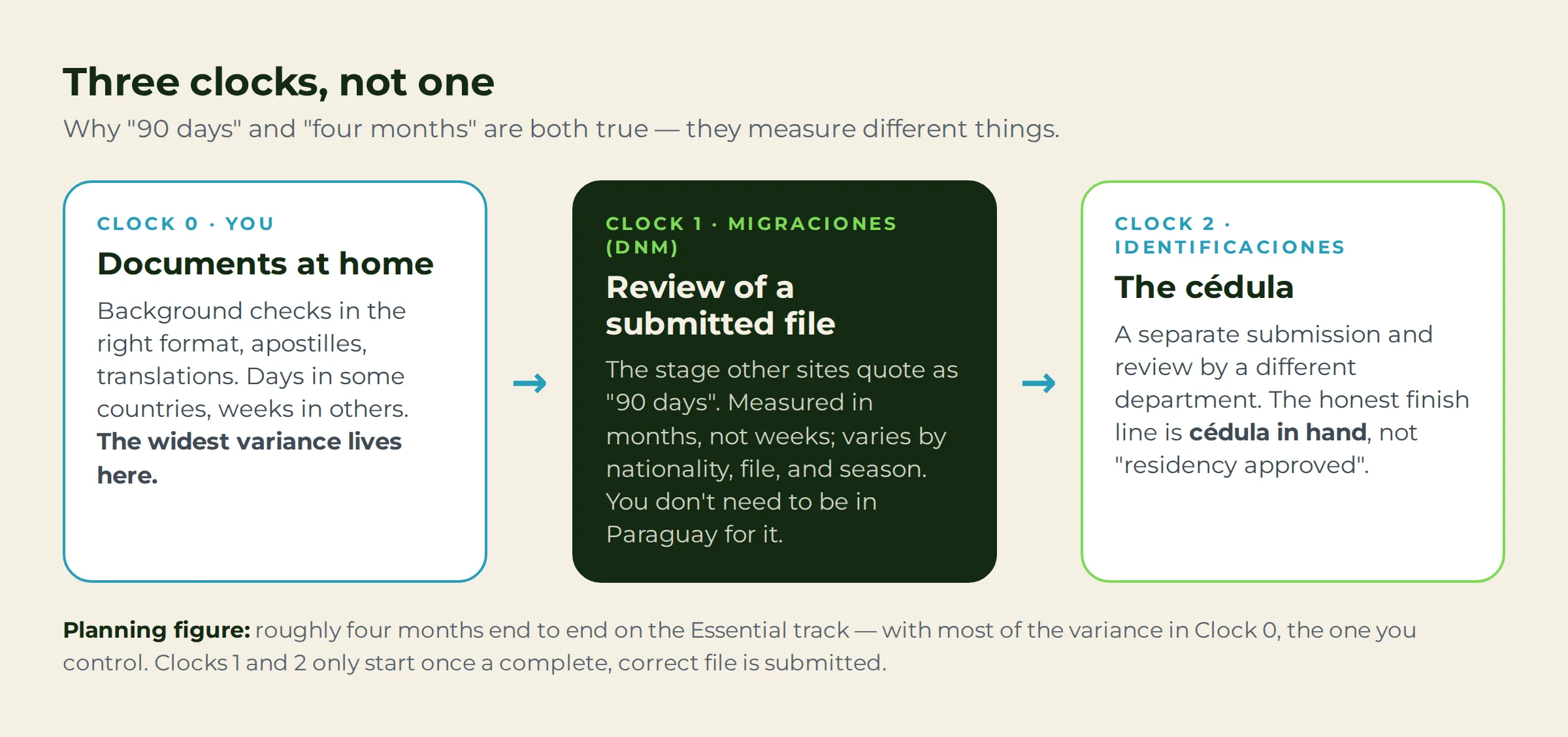
The clock nobody puts in a headline: your documents at home
Before any government clock starts, there is the stage with the widest variance — and it’s the one you control. Criminal background checks in the exact format Paraguay accepts, apostilles on the right documents, translations. Some countries turn this paperwork around in days; others take weeks. Most stalled files stall here, not in Asunción — our country-by-country background check guide exists because this stage bounces more files than any government office does.
Two details worth knowing:
- The government clocks only start when a complete, correct file is submitted. A file bounced for a wrong-format background check doesn’t have a slow clock; it has a clock that never started.
- Some documents expire. Background checks and certain certificates have validity windows. Collected too early, in the wrong order, they age out before submission — which restarts this stage from zero.
Clock one: Migraciones — the “90 days” everyone quotes
When a website says Paraguay residency “takes 90 days,” it is quoting the review stage at the Dirección Nacional de Migraciones (DNM): the government examining a submitted temporary-residency application. Our honest description: measured in months, not weeks, varying with nationality, file complexity, and how busy the office is in a given season. Sometimes it runs faster than the quoted figure, sometimes slower — anyone promising you an exact day count is selling certainty they don’t have.
The good news about this clock: you don’t need to be in Paraguay while it runs. The review happens whether you’re in Asunción or Anchorage, and the finished documents can be picked up or shipped when they’re ready.
Clock two: Identificaciones — the cédula
Residency approval is not the end of the paperwork. The cédula — the Paraguayan ID card that makes your residency usable for daily life — is issued by a different department (Identificaciones, under the Policía Nacional) on its own schedule. It’s a separate submission, a separate review, and its own timeline; the cédula guide covers what it involves and what actually gates it.
The practical point: when you plan “how long until I’m done,” the honest endpoint is cédula in hand, not residency approved — and that means two government clocks in sequence, not one.
The number to actually plan around
Put the stages together — documents at home, the Migraciones review, Identificaciones — and you get the planning figure we give clients: roughly four months end to end on the Essential track. Some files run faster, some slower, and the variance overwhelmingly lives in the preparation stage, not in the government offices. The government stages are the most predictable part of the journey; the full step-by-step walks the whole path in order.
The other “90 days”: deadlines are not processing times
Paraguay’s process also contains fixed windows that have nothing to do with how fast anything processes — and the phrase “90 days” shows up here too, which is where the worst confusion comes from:
- Document validity windows, covered above — expiry dates on the paper you collect.
- The permanent-residency conversion window. Temporary residency runs two years, and the conversion file is submitted in a specific window near the end — with its own presence rule (you cannot have been outside Paraguay more than 365 days during the temporary period) and its own solvency requirements. That’s a planning exercise that starts in month one, not month twenty; the permanent residency guide covers it honestly.
Frequently asked
Is the 90-day figure a lie? No — it’s a real description of the Migraciones review stage, quoted as if it were the whole journey. Add document collection and the cédula stage, and roughly four months is the honest planning figure.
Do I have to stay in Paraguay while it processes? No. The reviews at Migraciones and Identificaciones happen whether you’re in the country or not.
Why do different websites quote such different times? Because they’re describing different stages — some quote only the Migraciones review, some include the cédula, few include the document stage where the real variance lives.
When should I book my flight? After your home-country documents are verified complete and correct — not before. That single habit prevents most timeline disasters.
Want realistic dates for your nationality and situation? Create a free account and tell us where you’re starting from — you’ll see how each step works and what your actual calendar looks like before you commit to anything.