
April 22, 2026 · Tax & Declarations
Paraguay's Territorial Tax System Explained: What Foreign-Source Income Actually Means in 2026
How Paraguay's territorial tax system treats foreigners in 2026: what personal income tax (IRP) actually taxes, why foreign-source income sits outside it, and the myths to skip.
Most people who type “Paraguay tax” into a search bar are hoping the first result will say zero. That’s the slogan version of the country’s tax system, and it’s the version that gets passed around on forums, in Telegram groups, and in YouTube videos that make Paraguay sound like a loophole. The truth is more useful than the slogan, and once you understand it, the country becomes more attractive — not less.
Paraguay runs a territorial tax system. That sentence is doing a lot of work, and the rest of this post is about unpacking what it actually means for someone moving here, billing foreign clients, holding investments abroad, or wondering whether residency will quietly drag their worldwide earnings into a Paraguayan filing.
What “territorial tax” actually means in Paraguay law
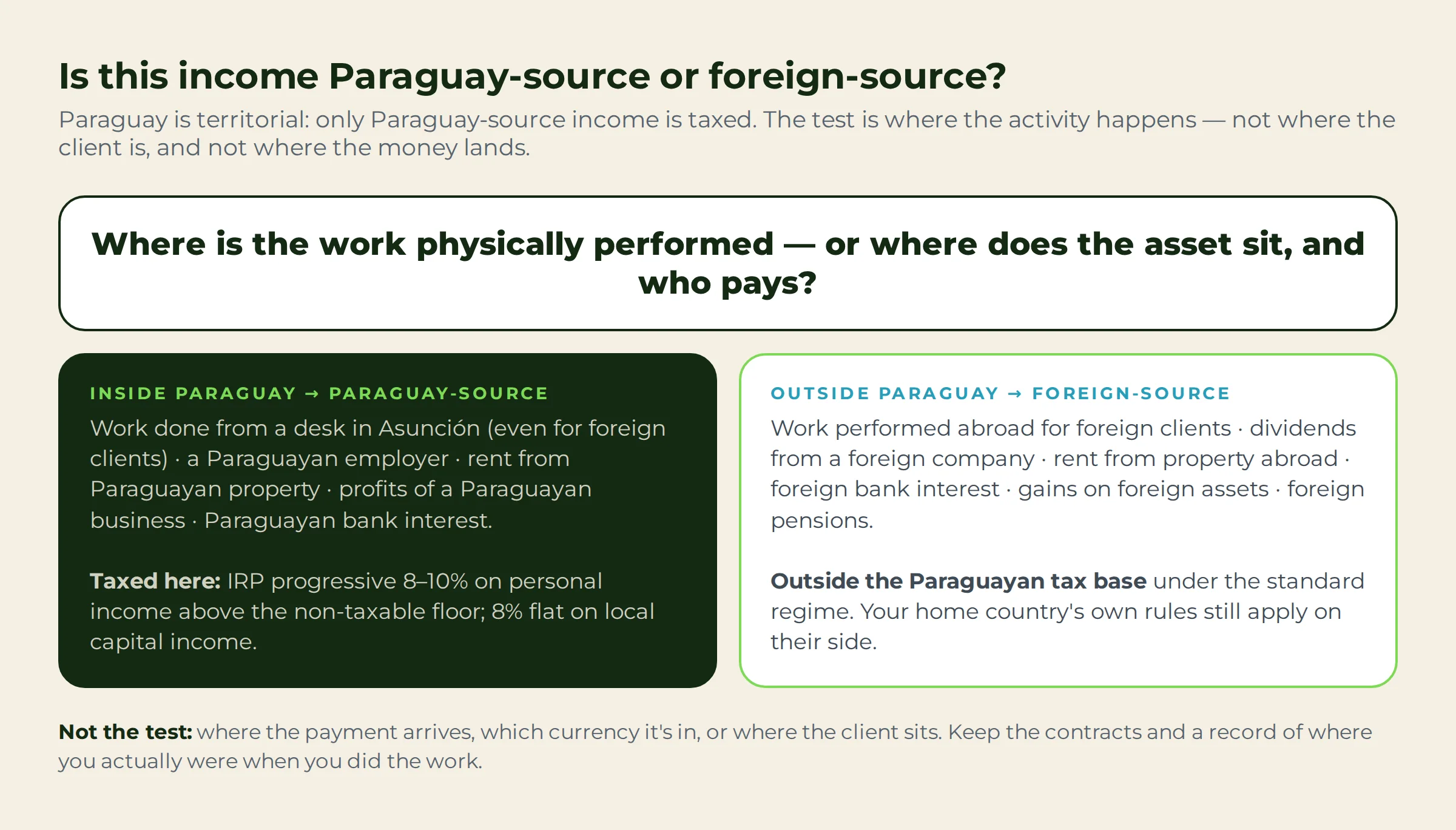
Under Paraguay’s standard tax regime, only Paraguay-source income is taxed domestically. Foreign-source income — income whose economic activity, client, or asset sits outside Paraguay — falls outside the country’s tax base. Paraguay simply does not assert tax jurisdiction over it.
Compare this to the United States, which taxes its citizens on worldwide income regardless of where they live, or to most European countries, which tax residents on worldwide income once they cross a residency threshold. Paraguay does neither. The tax authority — DNIT (Dirección Nacional de Ingresos Tributarios), the consolidated tax-and-customs authority created in 2023 under Ley 7143/2023 by merging the former SET (Subsecretaría de Estado de Tributación) with the customs agency (DNA) — concerns itself with what happens economically inside Paraguay’s borders.
That is the entire premise. It is not a loophole. It is not a special deal. It is the structure of the tax code, written into law, and it has been the structure for decades. The territorial principle is what makes Paraguay genuinely different from the worldwide-tax majority — and it is the reason most of our clients moved here in the first place.
What “Paraguay-source” looks like in practice
The line between Paraguay-source and foreign-source income is usually obvious, occasionally subtle, and almost always answerable with a clear test: where was the economic activity that generated the income? The test is grounded in the Spanish-language phrase the law uses — fuente paraguaya — which translates literally as “Paraguayan source,” and the legal framework leans on three anchors: where the activity occurred, where the asset is located, and where the payer of the income sits.
Paraguay-source income typically includes:
- Salaries paid by a Paraguayan employer for work performed in Paraguay.
- Income from services you perform while physically in Paraguay — whoever the client is and wherever they pay from.
- Rent collected on Paraguayan real estate.
- Profits from a Paraguayan business, whether sole-proprietor or company.
- Interest paid by a Paraguayan bank or Paraguayan-issued instrument.
- Capital gains on the sale of Paraguayan-situated assets.
- Royalties for the use of intellectual property exploited inside Paraguay.
Foreign-source income typically includes:
- Consulting or freelance fees for work performed outside Paraguay, billed to clients outside Paraguay.
- Dividends from a foreign company.
- Rental income from property located in another country.
- Interest from a foreign bank account or foreign-denominated instrument.
- Capital gains on the sale of assets located outside Paraguay.
- Royalties or licensing income from intellectual property exploited outside Paraguay.
- Pensions and retirement payments from foreign systems and foreign employers.
The practical takeaway: a consultant who does the work from outside Paraguay — based abroad, or travelling — and bills US, European, or Asian clients is generating foreign-source income, outside Paraguay’s tax base under the standard regime. The same consultant doing that same work from a desk in Asunción is performing the activity in Paraguay, and that income is Paraguay-source — taxable here above the non-taxable floor, at IRP’s ordinary rates. Both are legitimate setups; they are simply filed differently, which is why “where will you physically be when you work?” is the first question we ask anyone planning to live and work here.
A second example worth holding in mind: a retired American living in Asunción who collects a US Social Security payment, a private US pension, and dividends from a US brokerage account is, in Paraguayan terms, a person with three streams of foreign-source income. None of those streams is inside Paraguay’s tax base. Their separate question — what the United States does to that income, given US worldwide taxation of citizens — is a different conversation, with different paperwork, and not one Paraguay’s territorial system answers.
The mistake we see most often is people assuming the test is “where does the money land?” or “where is the client?” It’s neither. Being paid into a foreign account for work you performed at a desk in Asunción doesn’t make that income foreign-source; and travelling abroad while your Paraguayan business books revenue from Paraguayan clients doesn’t make that income foreign-source either. Where the activity is performed, where the asset sits, and who pays are the anchors — not the bank account the money lands in.
IRP: the personal income tax that actually applies
Paraguay’s personal income tax is called IRP — Impuesto a la Renta Personal. The headline rate runs up to 10%, which is what people quote when they want to make the country sound favorable. The number is real. The framing usually misses what IRP actually taxes.
IRP applies to Paraguay-source personal income, with a non-taxable threshold (currently around Gs. 80,000,000 in annual personal-services income) below which you owe nothing. The structure is stable across years; only the threshold and bracket figures shift with the annual salario mínimo update.
Under Ley 6380/2019 the IRP splits into two distinct sub-regimes, each with its own rate structure and its own monthly form on Marangatu:
- IRP-RSP — Rentas por Servicios Personales. Income from personal services — consulting, freelance, professional services, employment. Progressive rates of 8%, 9%, and 10% across three brackets, with a broad set of deductible expenses tied to the activity. Filed via Form 715.
- IRP-RGC — Rentas y Ganancias del Capital. Income from capital — dividends, interest, rental income, capital gains. Flat 8%, narrower deductions. Filed via Form 716.
The two sub-regimes are not “the same framework with different deductions” — they are separate filings with different rates. For most expats with foreign clients, neither sub-regime captures their main income (foreign-source is outside the IRP base entirely); IRP exposure appears only when local Paraguayan clients, local rental properties, or local capital instruments enter the picture.
What IRP does not do is reach across borders. Foreign-source personal income — your foreign consulting fees, your foreign dividends, your foreign rentals — is not within the IRP base. The territorial principle holds at the personal level just as it does at the corporate level.
So the honest version of the headline is: Paraguay-source personal income is taxed at progressive rates up to 10%, with a non-taxable floor; foreign-source personal income falls outside Paraguay’s tax base under the standard regime.
There is also a separate corporate-level tax called IRE — the income tax for businesses, structured around a 10% rate on Paraguayan-source profits — and a tax on dividends called IDU when those dividends leave a Paraguayan company. For most individual expats, IRE and IDU only matter if you set up a Paraguayan company. If you stay on the personal-IRP track, the corporate layer doesn’t apply to you.
”Not taxed” is not the same as “not reportable”
This is where most online explanations get sloppy, and where careful people stay out of trouble.
The fact that your foreign-source income is outside Paraguay’s tax base does not, by itself, give you a clean documentary trail when a bank or counterparty asks where your money came from. Banks sometimes ask. When they do, the answer they want is documentary, not jurisdictional.
The challenge is that “Paraguay doesn’t tax this” is the wrong answer to “where did this money come from?” The first is a jurisdictional statement; the second is an evidentiary one. The evidentiary answer is documentation you can produce on demand — a record of the foreign source itself, a record of the transfer path, the contracts or statements that show what produced the income. Paraguay’s tax administration doesn’t generate those; they are produced on the foreign side, by you, and kept where you keep your other source-of-funds records.
There is also a distinct question about reporting in your home country. Paraguay’s territorial treatment is purely a Paraguayan-side fact. If you remain a citizen or tax resident of a country that taxes worldwide income — the United States is the most obvious example, but several others have similar reach — your domestic obligations don’t disappear because Paraguay doesn’t tax the same income. That is a parallel track, not a contradiction, and we mention it because new arrivals sometimes hope the territorial system will solve a problem it was never designed to address.
The forum myth: “getting a RUC exposes worldwide income”
Walk through any expat-in-Paraguay forum long enough and you will find someone insisting that getting a RUC — Paraguay’s tax ID — somehow extends Paraguay’s reach over your worldwide earnings. The claim is wrong. It is also persistent, because it sounds plausible if you are used to worldwide-tax jurisdictions where every registration adds to your filing burden.
Registering for a RUC does not change the territorial principle. It does not expand Paraguay’s tax base. It does not magically pull foreign-source income into the IRP base. What it does do is enroll you in Paraguay’s tax administration system — meaning you get a tax ID, you can issue invoices, you can prove tax residency, and you take on a monthly filing obligation for the periods covered. It has also picked up a residency role: a RUC in good standing is now the standard proof of economic solvency when you convert temporary residency to permanent. None of that touches what Paraguay decides to tax.
We’ve laid out the practical commitments of holding a RUC in what a RUC commits you to. For the territorial question specifically: the RUC is a registration, not a jurisdiction expansion.
Edge cases: when the source line isn’t obvious
Most situations fit cleanly inside the territorial framework. Some don’t. We see this with clients who have:
- Hybrid contracts where part of the work happens in Paraguay and part abroad.
- Foreign companies that pay them dividends but also use them as Paraguay-based consultants.
- Royalty or intellectual property income with mixed jurisdictional ties.
- Cross-border partnerships where the source of profits is genuinely contested.
- E-commerce structures where customers, fulfillment, payment processors, and operators all sit in different countries.
- Investment income from instruments that are technically foreign but routed through a Paraguayan custodian.
The test that resolves most of these is the one the law itself uses: where is the activity physically performed? Work done outside Paraguay for foreign clients is foreign-source. Work performed while you are physically in Paraguay is Paraguayan-source, even when the client and the money are abroad — which is why “where will you actually be sitting when you work?” is the first question we ask anyone planning to live and work here. Both setups are legitimate; they’re structured and filed differently, and the honest move is to decide which one describes you before the first invoice, not after.
For the genuinely mixed cases — the hybrid contract, the contested partnership — the answer comes from the facts and the records you keep of them, and from qualified advice for your specific situation. What it does not come from is a slogan. Keep the contracts, the location record, and the payment trail, and the classification usually writes itself.
What this means if you’re moving to Paraguay
If your income is mostly foreign-source — remote work for clients abroad, foreign investments, foreign rentals — the territorial system means Paraguay does not tax that piece. Your local tax footprint is shaped by what you do economically inside Paraguay: do you take on local clients, hold local property, run a local business, draw a local salary?
For a remote-working expat with foreign clients only, the practical Paraguayan tax bill on the personal side can be small or nothing, while the documentary trail — the RUC, the monthly filings, the IVA position month to month — is what actually matters in the long run. The system is generous on rates and strict on paperwork. We think that’s a fair trade, and it’s the trade we help clients make every month.
The opposite mistake — assuming Paraguay is a paperwork-free zero-tax haven — is the one that creates problems years later when a foreign bank asks for documentation you never bothered to generate. The territorial system is real, but using it well still means treating Paraguay like a real country with a real tax administration.
A few practical patterns we see work well:
- Keep the source separation clean. Foreign-source income flows into foreign accounts; what you bring into Paraguay enters as personal funds. Mixing them on a single Paraguayan invoice line is the easiest way to muddle the analysis.
- Don’t invent local activity to justify a registration. If you don’t have Paraguayan economic activity yet, don’t manufacture some — register on what you actually have, and add to it as your situation grows. Registering with no local activity yet isn’t inventing anything, to be clear: plenty of people register honestly at zero because a RUC kept in good standing is the standard solvency proof for the permanent-residency conversion.
- Match the paperwork to the use case. A retiree with foreign pensions and no local clients does not need an aggressive IVA setup. A consultant with a mix of foreign and local clients does. The system is flexible; the goal is to use the right amount of it.
Paraguay rewards people who treat it like a real country. The territorial system isn’t a shortcut around the responsibilities of residency; it’s a structurally different way to define what those responsibilities cover. Once you internalize that, the rest is logistics — and logistics we can handle.
What to do next
If you are still working out whether Paraguay’s territorial tax system fits your situation, create a free account and tell us the shape of it — what kind of income you have, where it is sourced, what your residency timeline looks like — and we’ll walk you through the questions that actually matter. If you already know the answer and want the local team that handles the monthly filings and the RUC paperwork without you thinking about it, our accounting service is the relief valve. Either way, hand in your receipts — we do the rest.