
August 29, 2026 · Documents
The Vida y Residencia Certificate: What It Is, When You Need It, and How to Get It
Certificado de Vida y Residencia in Paraguay: what it proves, who issues it, the address and witnesses it needs, when the cédula or a bank wants it, and what we handle.
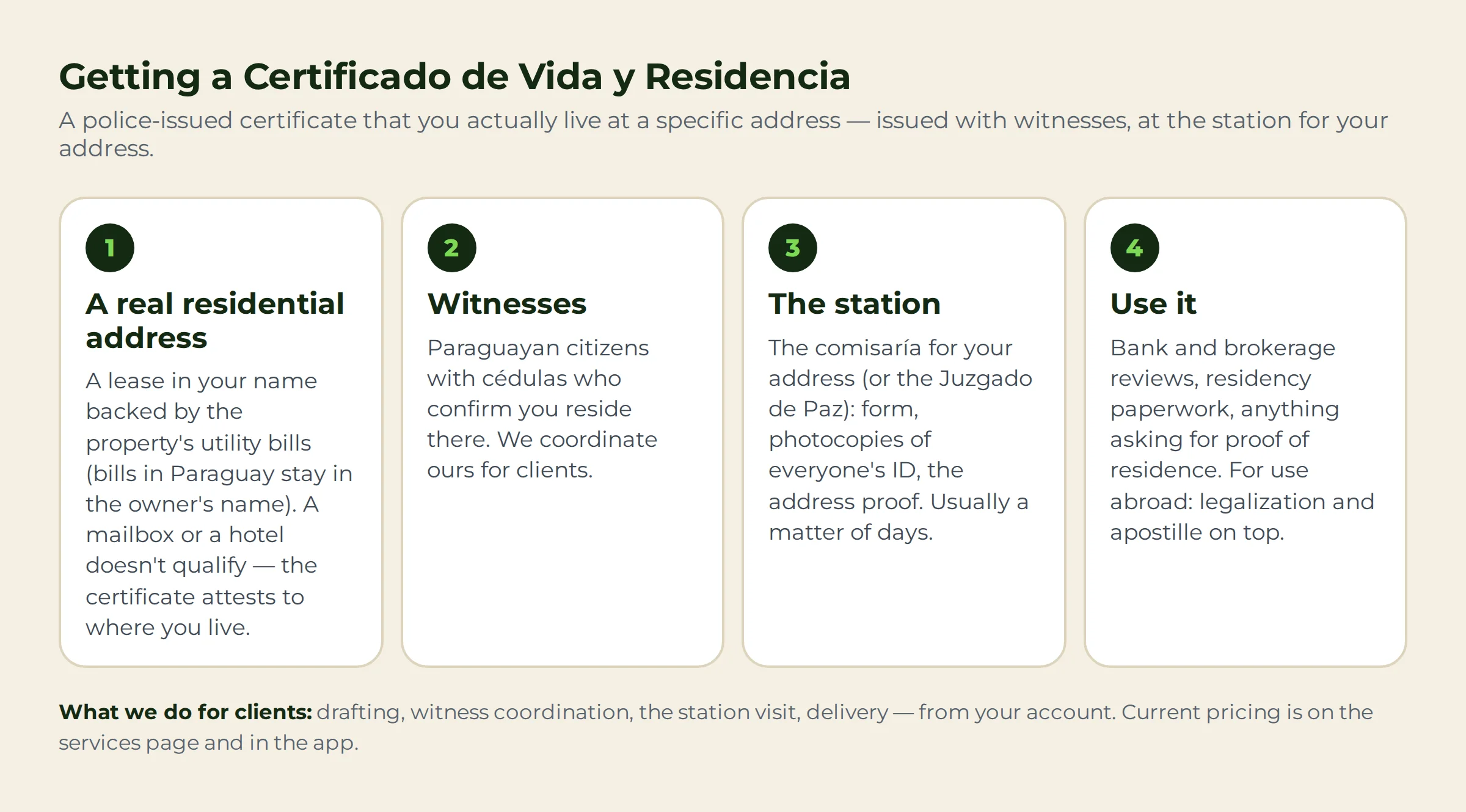
The Certificado de Vida y Residencia is a short police certificate stating two things: that you are alive, and that you live at one specific address in Paraguay. It’s issued by the comisaría — the police station for the neighbourhood you live in — or by the local Juzgado de Paz, and it rests on three things: a residential address you can document (a lease in your name, or the property’s utility bill), copies of your ID, and witnesses — in practice two Paraguayan citizens with their cédulas — who confirm you actually live there. You need it for the cédula file, and it comes up again with banks, brokers, and foreign paperwork that want an official Paraguayan document saying where you live. A hotel, an Airbnb, or a mailbox can’t produce one, because the certificate describes where you live, not where your mail finds you. Once the address paperwork exists, getting it is usually quick — often a matter of days.
Most of the confusion we see comes from the name: residencia here has nothing to do with the residency permit. It’s a much humbler document — a neighbourhood police station putting its stamp on the sentence “this person lives here” — and holding on to that idea clears up almost every question that follows.
What the certificate actually says
The name makes more sense once you know who else uses it. The classic case is a Paraguayan pensioner living abroad: the social security institute (IPS) wants periodic proof that the person is still alive and still where they said they were, and the consulate issues exactly this certificate — a fe de vida y residencia. That’s the vida half. For a foreign resident, the vida part takes care of itself; the residencia half is the whole point.
Read literally, it says: on this date, this person resides at this address, as confirmed by the documents presented and the witnesses who signed — and the head or deputy head of the station signs it. Behind it sits a paper trail (the form, your ID, the witnesses’ IDs, the bill or lease for the dwelling), which is why it carries weight with institutions that won’t take a lease on its own. A lease is a private contract between you and a landlord; the certificate is the state saying it looked at your paperwork and two of its citizens vouched for you.
Who issues it and what they ask for
The Policía Nacional’s published requirements are short. As of August 2026 the pages date from mid-2022, and they match what we see at the counter:
- The form. The comisaría supplies its own solicitud de vida y residencia; you don’t bring one.
- ID copies. A photocopy of your identity document and of each witness’s cédula. If you don’t have a cédula yet, the passport is your ID.
- Proof of the dwelling. An ANDE (electricity), ESSAP (water) or COPACO (telecom) bill for the address, or the rental contract.
- Witnesses. The official text just says “the witnesses”; in practice the station expects two Paraguayan citizens, who sign alongside their cédula copies. They are vouching, personally, that you live there.
The comisaría has to be the one for your address — jurisdiccional — so a station across town won’t issue it; the Juzgado de Paz for the same district can. On timing, the police page says “a minimum of 24 business hours” once the file is complete; in practice it’s usually a few days, depending on the station’s workload and whether the paperwork was clean the first time.
One Paraguayan detail that trips up nearly everyone arriving from abroad: utility bills here stay in the property owner’s name and never transfer to a tenant. So the bill you hand the comisaría will almost never carry your name. That’s normal, and the station knows it: the bill proves the dwelling exists and is serviced; the lease is what ties the dwelling to you.
When you need it — and when you don’t
Temporary residency: no. The Migraciones list under Law 6984/22 asks you to declare your domicile in Paraguay under oath, along with your profession; it doesn’t ask for a certificate proving it.
The cédula: yes, and with extra stamps. The certificate is on Identificaciones’ requirement list for a foreigner’s first cédula, and for that use it can’t go straight from the comisaría to the counter. Identificaciones wants it signed by the head or deputy head of the station, then authenticated by the police’s Dirección General de Talento Humano, then legalized at the Comandancia de la Policía Nacional. Three offices, in that order, before it’s a finished document.
There’s a freshness catch. Nobody prints an expiry date on the certificate, but the local documents in the cédula file are all treated as short-lived — under three months old at filing is the rule we plan around — and this is one of them. Order it when the rest of the file is nearly ready, not the week you land. The address on it also has to match the domicile you declared to Migraciones — a mismatch is one of the quieter reasons a cédula file comes back across the counter, and it’s why the kind of address matters (more below).
Converting to permanent residency: sometimes. It isn’t on Migraciones’ published list for the change of category, but supporting documents come up case by case at that counter, and a fresh Vida y Residencia has been one of them. Our permanent residency guide covers what the conversion file actually turns on and where the certificate fits.
Banks and brokers: often. Once you’re past a basic account, a Paraguayan bank — and, more and more, an online broker abroad — wants official proof of where you live, and a lease alone doesn’t always satisfy them. A recent Vida y Residencia is a government-issued certificate with your name and address on it. Each institution sets its own recency window and its own list, so ask them exactly what they’ll accept before you order anything; we don’t check your bank’s requirements for you, because only the bank can answer that.
Paperwork abroad: yes, with an apostille. If a tax office, a bank, or an authority outside Paraguay asks you to prove you actually reside here, this is the document that answers it in a form they can verify. Paraguay has been in the Hague Apostille Convention since August 2014, so the certificate can be apostilled through the Foreign Ministry’s legalizations department for use in any member country, plus a sworn translation if the receiving country needs it in another language.
Can a hotel address work?
No. This is the question we get most, usually from someone in a good hotel in Villa Morra or a short-term flat in Carmelitas who reads the requirements and figures the front desk can write something. The certificate attests to where you live. A hotel is where you’re staying — a business, not a dwelling; the utility bills belong to the business, and there’s no lease with your name on it to put in the file. The comisaría won’t issue against it, and if one somehow did, the cédula counter would catch the mismatch with your Migraciones file.
Airbnbs fail the same way. We get the Airbnb version of this question most months, and the answer is the same every time: the “rental contract” the police mean is a residential lease for a dwelling you occupy, not a booking confirmation, and the bills belong to a landlord who has never heard of you.
Can the mailbox address be used?
Also no, and this is the one that matters most to understand. A mailbox is a service address — a real building in Asunción where your mail is received, scanned and forwarded, and where notices from the tax authority or a bank can reach you. It’s the right tool for correspondence and for the notice address on your RUC. But nobody lives there. The building’s records reflect a service relationship, not a tenancy, and a police station can’t certify residence at a place where you don’t reside. Hand a mailbox address to the comisaría — or to Identificaciones, or to a bank’s review team — and the file bounces.
What the certificate needs is a real residential address — a lease in your name backed by the property’s utility bills, with the reminder that in Paraguay those bills always stay in the owner’s name. If you already rent a place in your own name, you have everything you need. If you don’t — you’re arranging the cédula from abroad, or you’re here on a short visit and haven’t signed a lease — that’s something we set up for clients privately, case by case, through the account, built around what you’re actually trying to satisfy. The full difference between the two kinds of address is laid out in mailbox vs. real residential address; the short version: one receives your mail, the other is where you live, and this certificate only cares about the second.
What we handle, and what you do
We went through this ourselves before we did it for anyone else, and the honest summary is that the document is easy and the logistics are irritating: the right station, its form, two witnesses with their cédulas, a bill from the landlord, then two more offices for the stamps if it’s for the cédula.
For Sweet Home Paraguay clients, the certificate is a done-for-you item. Our side:
- Drafting. The application, filled in the way the station expects, with the address matching your Migraciones file to the letter.
- Witnesses. We coordinate the two Paraguayan witnesses and their documents — no asking a friend of a friend to sign a police form for you.
- The address paperwork. If you rent in your own name, we work from your lease and the owner’s bill. If you don’t, we tell you plainly what’s missing and how it gets set up.
- The stamps. If it’s for the cédula, we take it through Talento Humano and the Comandancia so it arrives finished.
- Delivery. The original is handed to you or kept for the cédula file, and a scan goes into your account the day it’s issued, in your vault with the rest of your file.
Your side is short: a clear photo of your passport or cédula, the address paperwork if you have it, and — the one we underline — what you need the certificate for. That determines which stamps it needs and when to time it; a certificate ordered for the wrong purpose or three months too early is one you’ll order twice. Current pricing is on the services page and in the app.
Two things we’ve learned the hard way: keep a copy of the finished certificate and a note of who the witnesses were, in case a later step asks who signed; and if you’re doing this as a couple, each of you gets your own certificate — there’s no joint version.
Frequently asked
How long is a Vida y Residencia valid? The certificate itself doesn’t carry an expiry date; the institution asking for it decides how fresh it has to be. For the cédula file, plan on it being under three months old when you submit. Banks and brokers set their own window and will tell you when you ask.
Do I need one to apply for temporary residency? No. The residency application takes a sworn declaration of your domicile, not a certificate. The Vida y Residencia enters the picture at the cédula stage, after residency is approved.
My bank wants a utility bill in my name. Can you get one? Not in Paraguay. Bills stay in the property owner’s name here and never move to a tenant. What exists instead is a lease in your name plus the owner’s bill and, on top of that, this certificate as an official document with your name and address on it. Ask your bank whether that combination works before you order anything.
Does the address on it have to match my Migraciones address? For the cédula, yes — a mismatch is a common reason a file comes back. If you’ve moved since you filed, update the domicile with Migraciones first, then get the certificate for the new address. More address questions are answered in our FAQ.
If you’re not sure whether the paperwork you have would hold up at the comisaría — or whether you need this certificate at all yet — create a free account and tell us your situation in the chat: where you’re living, what you’re applying for, and who’s asking for proof. We’ll tell you straight whether you need it, when to order it, and what has to exist first. Then you can get on with the part of Paraguay you actually came for, and we’ll deal with the station.