
August 29, 2026 · Residency Process
Paraguay Residency When You've Been Away More Than a Year: What to Do
Paraguay residency 365-day rule: what happens if you're away more than a year on temporary residency, how to check your entry and exit record, and the honest options.
Short answer: if you hold temporary residency in Paraguay and you’ve been outside the country for more than 365 days in a row, the door to permanent residency is closed as things stand. Law 6984/22 lets Migraciones cancel a temporary residency for an unjustified continuous absence of more than one year, and in 2026 the Dirección Nacional de Migraciones (DNM) checks your entry and exit record when you file to convert — emailed explanations for a missed visit are not being accepted. What you do next depends on the calendar. If you haven’t crossed 365 days yet, come back before you do; even a short visit resets the count. If you have already crossed it, the realistic path in our experience is a fresh application on the Essential track, not a “renewal”. And if you’re already a permanent resident, breathe: that status is far more forgiving — roughly one visit every three years keeps it alive.
This is the message we get most often from clients who are abroad, usually phrased as “I think I’ve been gone too long — what now?” Here is the honest version, in the order you’ll need it.
What the rule actually says
The rule lives in Article 55 of Law 6984/22, the 2022 migration law. Migraciones may cancel a residency for an unjustified absence from the country of more than one continuous year for a temporary resident, or more than three continuous years for a permanent resident, unless the absence was authorized by Migraciones. DNM restated exactly this in an April 2026 reminder to foreign residents, which is the clearest sign that the rule is now being applied, not just printed.
Three details are worth reading twice, because each one has caught a real file:
- It’s continuous, not cumulative. The count is the longest unbroken stretch outside Paraguay, not the total days abroad across your two temporary years. Someone who flies in for a week every ten months stays inside the rule; someone who goes home for fourteen straight months does not.
- Where the clock starts. In our experience the first stretch is measured from the issuance date printed on your temporary card — not from the day you last flew out — and after each visit, from your most recent recorded exit. Don’t plan to the day either way. Arriving a few days before the line is cheap insurance; arriving the day after is a new application.
- Only recorded crossings exist. DNM’s record is built from entries and exits recorded at migration control posts. A land border crossed without passing migration control didn’t happen as far as the record is concerned. Get stamped, every time, and keep your own copy of the evidence.
On paper the law says Migraciones may cancel. In practice, the moment that matters is the conversion to permanent residency: the file is submitted, the record is pulled, and if it shows more than a year away in one stretch, the conversion doesn’t go through. That’s the failure mode we’re writing this post to prevent.
How to check where you stand
Don’t guess from memory. Three sources, in increasing order of authority:
- Your passport stamps and flight history. Good for a first pass, and usually enough to tell you whether you’re comfortably safe or uncomfortably close.
- Your temporary card’s issuance date. Take that date, or your most recent recorded exit if you’ve visited since, and add 365 days. That is your line.
- The official record. DNM issues a Constancia de Movimiento Migratorio — a certificate of your entries and exits as recorded at its control posts. It can be requested online through the paraguay.gov.py portal or in person, a representative can handle it for you, and the fee is currently Gs. 234,154 as of 2026 per the DNM page. This is the same record the conversion file is checked against, so it is the version that counts.
If you’re a Sweet Home Paraguay client, message us from your account first. We hold your card’s issuance date and your file history, and we’ll run the arithmetic with you — including whether a trip is needed and by when.
If you haven’t crossed the line yet: come back before you do
This is the good scenario, even if it doesn’t feel like it. A visit resets the count, and it doesn’t need to be long. Book it with a margin — a few days before the line, not on the line — and use the visit for whatever is easier in person anyway: collecting documents, checking on your address.
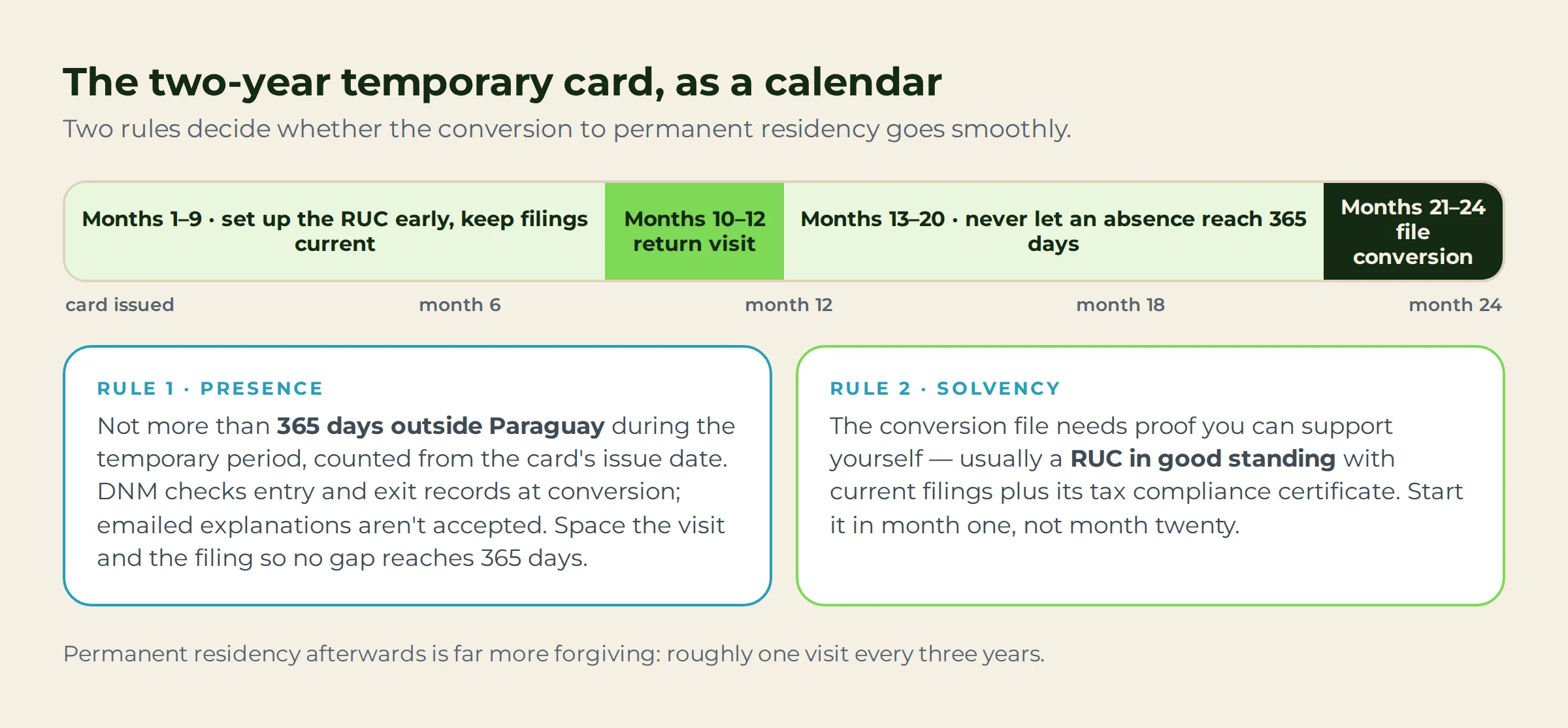
Then plan the rest of the temporary period around two dates. The conversion to permanent residency is filed in the last three months of your temporary card — months 21 to 24 on a two-year card. Pair your visit with that window so no stretch between visit and filing reaches 365 days; a visit around months 10–12 and a filing in months 21–24 is the rhythm we recommend. The permanent residency guide walks the whole conversion file, solvency proof included.
One more thing, because it’s in the law and people ask: Article 55 carves out absences that Migraciones has authorized, and DNM’s April 2026 notice says residents can request a prior authorization before exceeding the permitted absence. We mention it because it exists, not because it’s a plan: we haven’t seen an after-the-fact explanation substitute for the record, and we can’t promise what Migraciones would authorize in advance. The dependable tool is the return visit. If a long, unavoidable absence is coming — a medical situation, a family obligation — tell us before you leave, not after, while the options are still open.
If the 365 days are already behind you: the honest options
Start with what’s on paper, because you’ll find it on the DNM site and wonder why it doesn’t help. The official conversion page lets you file for permanent residency up to one month after your temporary card expires, paying the overstay multa (currently Gs. 702,462 as of 2026), and after that month only a temporary-residency extension can be requested — up to six months after expiry, granted for an equal period. Those mechanisms are real, and for someone whose only problem is a missed filing window, they’re the answer.
They are not the answer to a broken absence rule. Here is our operational experience in 2026, stated carefully: once the entry and exit record shows a continuous absence of more than a year, the temporary residency is in cancellation territory under Article 55, and neither the conversion nor an extension has been a workable path in the files we’ve seen. Explanations sent by email have not been accepted. The path that has actually worked is a new application — a fresh file with fresh background checks, apostilles, and translations, and a fresh in-person submission — on the Essential track, rather than any form of renewing the old card.
We say this as what we’ve seen at the counter, not as a legal ruling. Migraciones decides case by case, its practice moves, and if your absence had a serious reason behind it, qualified advice for your situation is worth getting before you choose a path. But we’d rather you plan for the realistic case than for the hopeful one.
What a second application looks like in practice:
- The knowledge carries over; the paperwork doesn’t. You know the offices and the shape of the process, which makes the second run calmer. The documents start from zero: the background checks have expired and the file is new.
- It’s the same process you did the first time. The step-by-step guide is still the map, and the honest planning figure is still roughly four months on the Essential track — the processing-time post explains where that time actually goes.
- The two-year clock restarts. Your conversion window and your citizenship clock both count from the new card, not the old one. That is the real cost of the missed visit.
- Enter as a visitor. If your temporary status has lapsed, you enter the way you did the first time — as a tourist, with whatever entry period your nationality gets — and file from there.
Current pricing for the Essential track is on the services page and in the app.
If you left mid-process
A lot of “I’ve been gone too long” messages come from people who never meant to stay away. They flew in, submitted the file, and life pulled them home before the card was ready. Two versions of this, and neither is a disaster if you read the calendar right.
You left after submitting, before the card was issued. The government review runs whether you’re in Asunción or anywhere else. But the card gets issued while you’re away, and in our experience the absence clock runs from that issuance date, not from the day you flew out. So the question is not “how long since I left?” but “how long since the card was issued?” Find out the issuance date — we tell clients the moment it happens — and plan a visit inside the year that follows it.
You left after the card, before the cédula. The card is yours; the cédula is a separate submission with its own timeline through Identificaciones. If the cédula paperwork was submitted before you left, it can be collected on your behalf by someone holding your power of attorney and sent on to you; courier costs vary widely by destination. If it wasn’t submitted, that’s a job for your next visit — and that visit doubles as your re-entry, which resets the absence count. Two errands, one trip.
In general terms, the power of attorney signed during your submission visit is what lets a representative collect documents and run inquiries for you while you’re abroad. Keep clean digital copies of everything — card, cédula, Residencia Precaria slip, every stamp — in one place. Your file is yours, and having it in hand from anywhere is half of what makes an absence manageable.
Permanent residency: the forgiving one
This is why the conversion is worth protecting. Once you hold permanent residency, the same Article 55 gives you three continuous years of absence before cancellation is on the table, which in practice means roughly one visit every three years to keep the card alive. The card itself runs ten years. For a nomadic or dual-base life, that is the difference between a residency you maintain and a residency you simply have.
The conversion file has its own conditions beyond the absence rule — the filing window above, and proof of economic solvency, for which a RUC in good standing plus its tax compliance certificate is the usual route. Both are planning exercises that start in month one of the temporary card, not month twenty. And the reason most people came — Paraguay’s territorial tax system, where foreign-source income sits outside the Paraguayan tax base and only Paraguay-source income is taxed — doesn’t change on either side of the conversion. The country does the heavy lifting. Your job is to not miss the visit.
Frequently asked
Does a short visit really reset the 365-day count? Yes. The rule is about a continuous absence, so any recorded entry breaks the stretch — a few days is enough in our experience. Make sure the entry is recorded at a migration control post, and arrive a few days before the line rather than on it.
Can I explain my absence to Migraciones by email? Not usefully, as of 2026. Migraciones goes by the entry and exit record, and emailed explanations for a missed visit are not being accepted. The law does allow a prior authorization requested before the limit is exceeded; after the fact, the record decides.
My temporary card expired while I was abroad. Can I renew Paraguay residency from overseas? A temporary-residency extension exists on paper — for a valid card, or up to six months after expiry with a fine — but the filings are done in Paraguay, not from abroad. And if your absence has passed a year, an extension has not been a workable path in our experience; the realistic route is a new application on the Essential track.
Does the 365-day rule apply once I’m a permanent resident? No. Permanent residents have three continuous years before cancellation is possible under Article 55 — roughly one visit every three years. More on maintaining permanent residency in our FAQ.
If any of this describes you — abroad, unsure of your dates, or already past the line — the single most useful thing you can do is tell us now rather than at month 23. Create a free account at app.sweethomeparaguay.com, give us your card’s issuance date and your last exit from Paraguay, and we’ll tell you plainly where you stand and what the next move is. Absences only become problems when nobody is watching the calendar. We’re there for you when you need us.